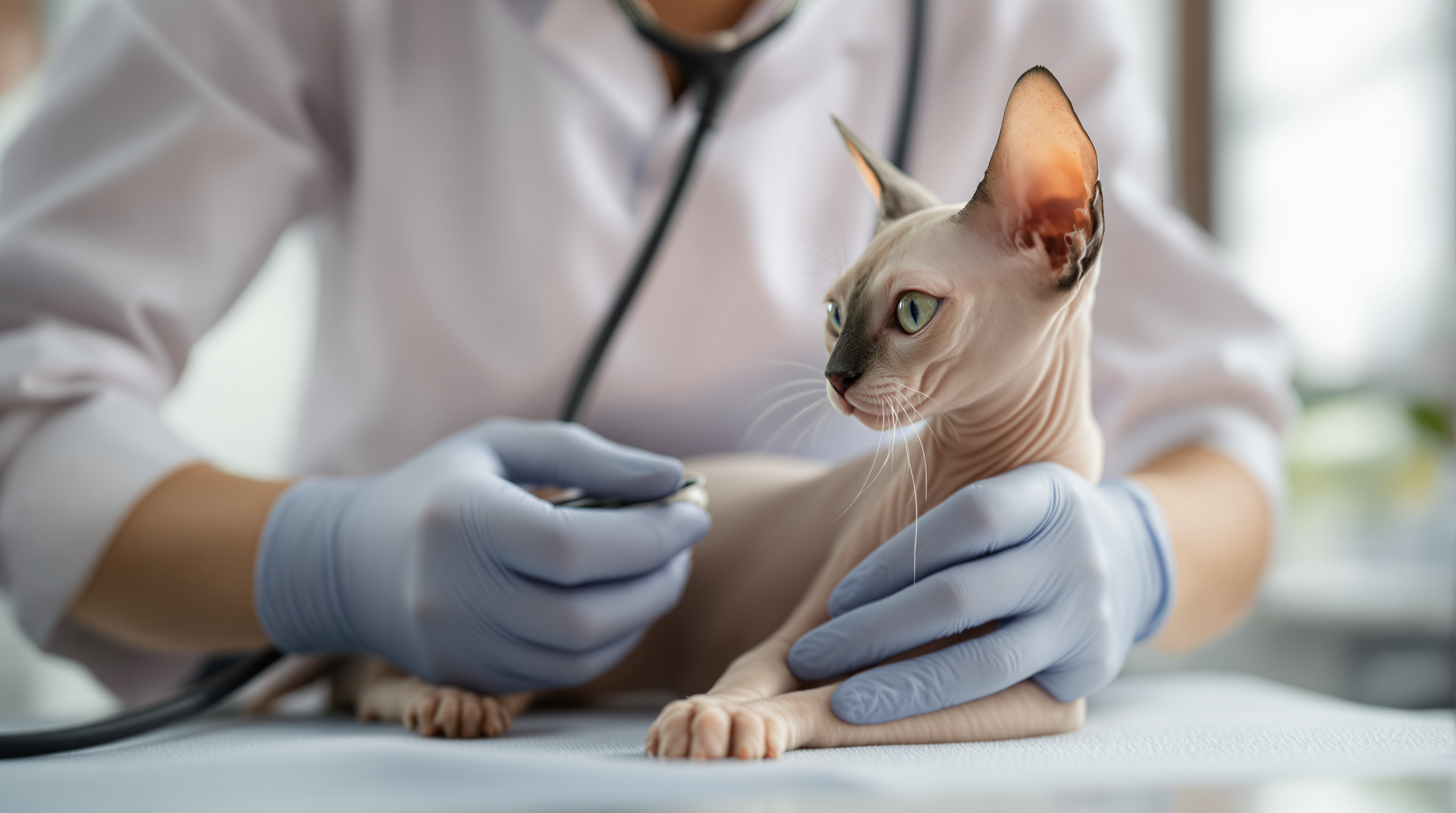
Understanding HCM, recent Sphynx studies, and the questions to discuss with your veterinarian.
Hypertrophic cardiomyopathy, usually shortened to HCM, is a condition in which the muscular walls of a cat's heart become thicker. Cornell Feline Health Center calls it the most common heart disease in cats. The name can sound daunting, but understanding what it describes gives you a starting point for conversations with your veterinarian.
Cornell explains that the left ventricle, the heart's main pumping muscle, is affected. Its thickened walls leave less space inside the chamber and do not relax normally. Less efficient pumping can contribute to fluid collecting in or around the lungs and to blood clots forming in the heart. HCM is generally progressive, although its effects vary considerably between cats.
Sphynx cats are among the breeds in which Cornell reports HCM is more prevalent. The same list includes Maine Coon, Ragdoll, British Shorthair, American Shorthair, Bengal, Chartreux, Norwegian Forest, Siberian, and Persian cats. HCM therefore concerns more than hairless breeds, and breed alone does not tell you whether an individual cat has it.
Cornell says the breed pattern and gene mutations identified in some affected cats suggest a genetic role, while the cause has not been clearly identified. This is useful context when asking about family records. Keep the question specific: what heart examinations were done, on which cats, and what did the reports say?
Cornell describes echocardiography as the method used to diagnose HCM. It uses sound waves to create images of the heart. In affected cats, those images show thickened walls and a smaller space within the left ventricle. This examination looks at the heart itself; a genetic result describes a gene variant.
When you receive a report, ask your veterinarian to explain what was seen and what the findings mean for your cat. A useful discussion separates the examination date, the findings, and any next steps. Keep copies of heart examination reports alongside genetic results so each can be understood in its own context, rather than treating them as interchangeable answers.
A 2024 study published in Animals screened 55 apparently healthy Sphynx cats from registered breeders and pet owners in New Zealand. A cardiologist examined the cats, and 42 had another cardiac examination after a median of 1.8 years. At a median age of 5.8 years, the authors reported HCM prevalence of 40% in the studied population.
The ALMS1 variant was found in 70.9% of the cats, but it was not associated with the HCM diagnosis in that population. The authors concluded that HCM was common in their cohort, suggesting a predisposition in Sphynx cats. Read the percentage as a finding about that group of cats, rather than a lifetime forecast or a diagnosis for your companion.
A 2026 study in Animals examined 47 Sphynx cats in Thailand using clinical information, heart ultrasound assessments, and ALMS1 genotyping. It found the ALMS1 p.G2462R variant in 44.68% of the sample. Researchers did not identify a significant association between that variant and the heart ultrasound measurements related to HCM in this population.
The Thai and New Zealand reports each examined a particular population. Their findings offer a reason to ask how a genetic result is being interpreted alongside a heart examination. Neither report supports using this variant alone as a diagnosis of HCM in an individual cat. Your veterinarian can explain what your cat's results do and do not establish.
Prevalence describes how many cats in a studied group had the condition. The frequency of a gene variant describes how many had that variant. Those figures answer different questions: the 70.9% figure from New Zealand refers to ALMS1, not to an HCM diagnosis. A lack of association in these samples does not mean that Sphynx cats have no heart disease risk. When reviewing a result with your veterinarian, name the test and the question it was meant to answer.
Cornell explains that many cats with HCM do not appear ill. Cats showing signs of congestive heart failure may have rapid or labored breathing, breathe with their mouth open, or seem lethargic. These signs can occur when fluid collects in or around the lungs. A cat's appearance at home therefore cannot tell the whole story about its heart.
Blood clots are another serious concern Cornell describes. A clot can travel and block circulation elsewhere; in cats with HCM, the hind limbs are the most common location. This can cause sudden pain or, in extreme cases, paralysis. Seek urgent help from your veterinarian for breathing difficulty or sudden hind-leg pain or loss of movement. Describe what you see without trying to diagnose the cause yourself.
For a planned discussion, bring any heart examination reports, genetic results, and available family history. Write down questions in plain language: What does the scan show? What does the genetic result mean in light of these studies? What should prompt urgent veterinary attention? Ask your veterinarian to decide what further assessment and follow-up are appropriate for your cat.
For background on the condition and its signs, read Cornell Feline Health Center's HCM guide. Keep the difference between general information, a study finding, and your cat's own examination clear. The aim is to understand the questions well enough to discuss them with your veterinarian, without turning a breed statistic into an individual prediction.